
6901 SW 14th Street, Des Moines, Iowa 50315
 DONATE
New to Zen?
DONATE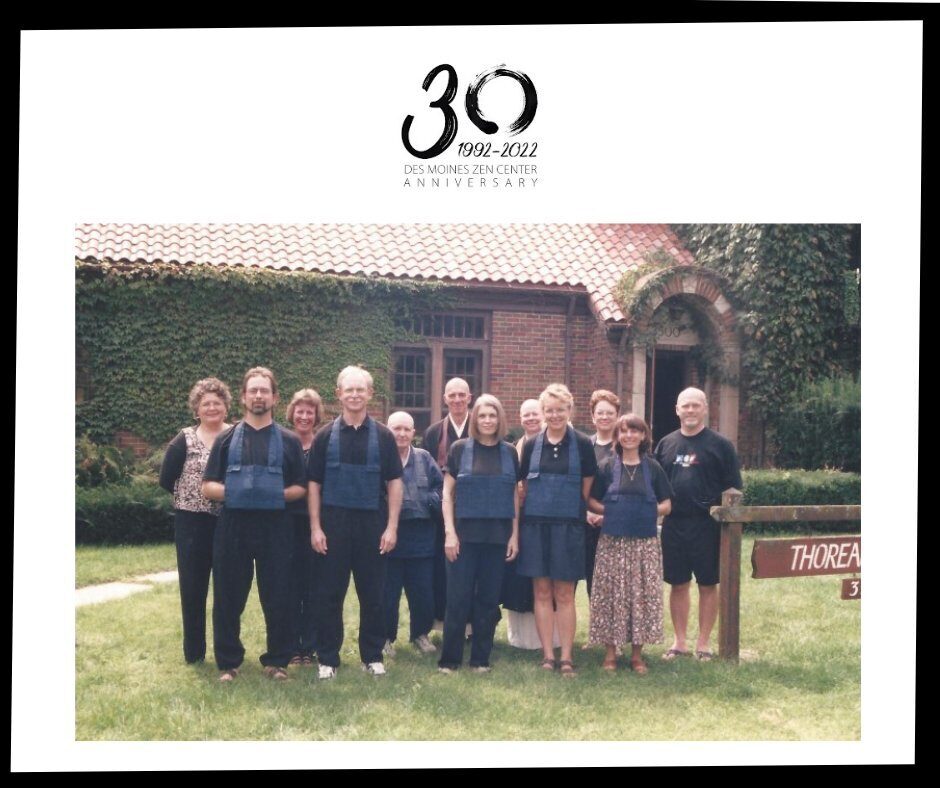
The Founding of the Des Moines Zen Center
The Des Moines Zen Center (DMZC) was founded by a small group of people interested in Zen Buddhism—particularly the practice of seated meditation, called zazen, and the support found in practicing together as a community, known as a sangha.
The beginning of DMZC can be traced to Palm Sunday in 1992, when Rev. Nonin Chowaney, then the abbot of the Nebraska Zen Center, gave a presentation at a church in Des Moines. Inspired by this talk, local practitioners soon began meeting weekly at the Thoreau Center on Kingman Boulevard. These early gatherings followed the Soto Zen tradition as it had been transmitted from Japan to the West.
In those first years, the group met in a community room with minimal equipment. Meditation cushions were carried in and out each week, and a simple altar and supplies were stored in a shoebox between meetings. Despite these humble beginnings, a strong and committed practice community began to form.
Early Teachers and Lay Ordination
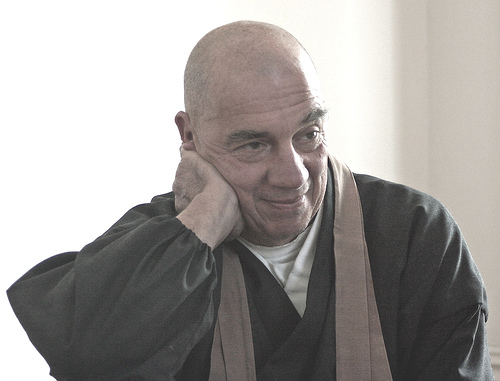
In 1998, Shoken Winecoff Roshi—then associated with the Decorah Zen Center and now abbot of Ryumonji Zen Monastery—and Rev. Zuiko Redding of the Cedar Rapids Zen Center began visiting Des Moines regularly. Their purpose was to guide sangha members in preparation for Jukai, a traditional lay ordination ceremony in Soto Zen.
As part of this preparation, students sewed a rakusu, a small patchwork garment worn around the neck. The sewing itself is considered a mindfulness practice, encouraging careful attention to each stitch and to the present moment—an expression of the heart of zazen practice.
On August 22, 1999, Rev. Winecoff, assisted by Rev. Redding and Rev. Jikan Kondrick, conducted DMZC’s first Jukai ceremony. Five members formally committed to “living by vow” through the recitation of the Sixteen Bodhisattva Precepts and the Verse of Formless Repentance.
Organizational Growth and a Permanent Home
In 2002, the Des Moines Zen Center adopted bylaws, defined its organizational structure, and incorporated as a 501(c)(3) nonprofit religious organization.
As the sangha grew, DMZC moved through several rented spaces over the years. These included an apartment near Drake University in 2001, a basement location south of Grand Avenue in 2010, and a former retail storefront on 35th Street in 2013. In 2018, the Center purchased its current building, establishing a long-term home for the community.
Throughout its history, DMZC has maintained a close affiliation with Shoken Winecoff Roshi and Ryumonji Zen Monastery. Members regularly travel there for intensive practice periods, including sesshin (multi-day meditation retreats) and ango (three-month residential training periods).
Priest Leadership and Temple Recognition
In 2010, Rev. Eido Espe became DMZC’s first head priest after receiving dharma transmission from Rev. Shoken Winecoff. During his tenure from 2010 to 2023, Rev. Espe ordained Rev. Eishin Houghton and Rev. Gendo Thornberry, guided the purchase of the current building, and led a multi-year effort to gain international temple recognition.
On May 19, 2021, Deep River Temple—formally named Shinsenji—received official international designation from Sotoshu, the Soto Zen administration based in Japan. This recognition established Shinsenji as the home temple of the Des Moines Zen Center. Sotoshu offered the prayer that the temple continue to develop in accordance with the teachings and rituals of Soto Zen.
After receiving dharma transmission in 2022, Rev. Eishin Houghton assumed the role of head priest in April 2023. Rev. Espe then transitioned to the role of emeritus priest.
The presence of Zen in Des Moines, and the establishment of Shinsenji, are part of a living tradition that traces back nearly 2,600 years to the awakening of Shakyamuni Buddha. While this lineage is ancient, Zen in America is relatively young—only about 60 to 100 years old, depending on how it is measured—and is now entering its third generation.
The Origins of Buddhism
Buddhism began with Siddhartha Gautama, later known as Shakyamuni Buddha, who was born a prince in what is now Nepal around 560 BCE. His mother died shortly after his birth, and his father raised him in great comfort, attempting to shield him from all forms of suffering.
As a young man, Siddhartha became dissatisfied with this sheltered life. Leaving the palace, he encountered sickness, old age, and death for the first time. Deeply affected by these realities, he left his home and family to seek an end to suffering—for himself and for all beings.
After years of intense ascetic practice, which he ultimately rejected as ineffective, Siddhartha sat in meditation beneath the Bodhi Tree, vowing not to rise until he awakened. After a long period of silent sitting, he experienced profound insight and declared, “I and all sentient beings have together awakened.” From that moment, he was known as the Buddha, meaning “the Awakened One.”
For the next fifty years, the Buddha taught what came to be known as the Dharma. These teachings include the Four Noble Truths and the Eightfold Path, among many others, all pointing toward wisdom, compassion, and freedom from suffering.
According to Zen tradition, on one occasion the Buddha silently held up a flower before an assembly of students. Only one disciple, Mahakasyapa, understood and smiled. The Buddha then declared that he was transmitting the “Treasury of the True Dharma Eye” to Mahakasyapa. This wordless, mind-to-mind transmission is considered the beginning of the Zen lineage.
Over centuries, this tradition spread from India to China, where it became known as Chan. In the 13th century, the Japanese monk Eihei Dogen transmitted this lineage from China to Japan, founding the Soto Zen school. From Asia, Buddhism has continued to spread worldwide, giving rise to many schools and traditions, each emphasizing different combinations of devotion, study, and meditation.
Our Lineage and Practice
The Des Moines Zen Center follows the Soto Zen tradition established by Eihei Dogen. This tradition places primary emphasis on zazen, or seated meditation, also known as shikantaza, meaning “just sitting.” This practice is rooted in the Buddha’s own meditation and emphasizes calm awareness of the present moment.
Interest in Eastern philosophy and spirituality began reaching the West in the late 19th century, gradually increasing through cultural exchange. By the mid-20th century, Zen practice began attracting people beyond Asian immigrant communities.
In 1959, Japanese Zen priest Shunryu Suzuki arrived quietly in San Francisco to serve the Japanese-American congregation at Sokoji Temple. Under his guidance, interest in Zen practice among Westerners grew rapidly, leading to the founding of San Francisco Zen Center in 1962 and Tassajara Zen Mountain Center in 1967—the first Soto Zen monastic training center outside Japan.
In 1966, another Japanese priest, Dainin Katagiri, joined Suzuki Roshi in teaching this expanding community. After Suzuki’s death, Katagiri moved to Minneapolis in 1972, where he founded the Zen Meditation Center of Minnesota and later Hokyoji, a rural practice center. Although Katagiri Roshi passed away in 1990, his influence remains profound. Several of his dharma heirs—priests who received transmission from him—have remained in the Midwest, and four have directly supported the development of the Des Moines Zen Center. Ryumonji Monastery is a culmination of Katagiri’s vision of the future of Zen.
DMZC also rests within this lineage.
Over the years, the Center has benefited from many visiting teachers, including Rev. Nonin Chowaney, Daiyu Klumpf, Dokai Georgesen, Rev. Teijo Munnich, the late Rev. Jikan Kondrick, and Shoken Winecoff Roshi. Most of these teachers either studied with or received dharma transmission from Dainin Katagiri.
The Center has also hosted visiting monks and priests from Japan, including Rev. Shohaku Okumura early in his time in the United States. Shohaku Okumura is a dharma heir of Kosho Uchiyama Roshi, the late abbot of Antaiji Monastery and one of the most influential Zen teachers of the 20th century. Known for his scholarship and translations—especially of Dogen’s writings—Shohaku Okumura led an early sesshin at DMZC that is remembered for its rigor and Shohakusan’s compassionate guidance.
In 2022, the Des Moines Zen Center celebrated 30 years of continuous practice. The path of Zen, often described as the pursuit of “suchness,” continues—moment by moment, together.
The Des Moines Zen Center is supported entirely by the generosity of its community. Our teachings, practice opportunities, and programs are offered freely and sustained through voluntary donations.
If you wish to support the ongoing work and practice of the Zen Center, you are invited to make a free-will offering. Donations may be given as a one-time gift or set up as a recurring offering. Please visit our Donation page or use the Donate button here to give securely by PayPal or debit/credit card.


.png)